Anyone can choose a city map poster by name. The hard part is choosing one that looks right on your wall. A city that means everything to you can still disappoint if it hangs too small, too high or in the wrong tone. The good news: four decisions control the result, and none of them needs a designer.
Start with the wall
Most people start with the city and finish with a compromise. Start with the wall and every later choice gets easier, because the wall limits the size, and the size decides how much detail you will see.
Write down three things:
- the width of the furniture under the spot, or of the free wall if there is none;
- the distance from which people will usually look;
- the color of the wall and the light that falls on it.
That note takes two minutes. It will save you from the most expensive mistake in home art, which is buying a frame twice.
Pick a city, then look at its shape
Begin with a place that means something: where you grew up, where you live now, where you met someone, or the city you keep finding reasons to visit. Meaning is what makes you stop in front of a map years later.
Then look at how that city draws. Streets, water and terrain give each place its own silhouette, and the differences are large.
| City | What the eye sees first | Feels |
|---|---|---|
| Miami | A wide, calm bay crossed by causeways | Open and quiet |
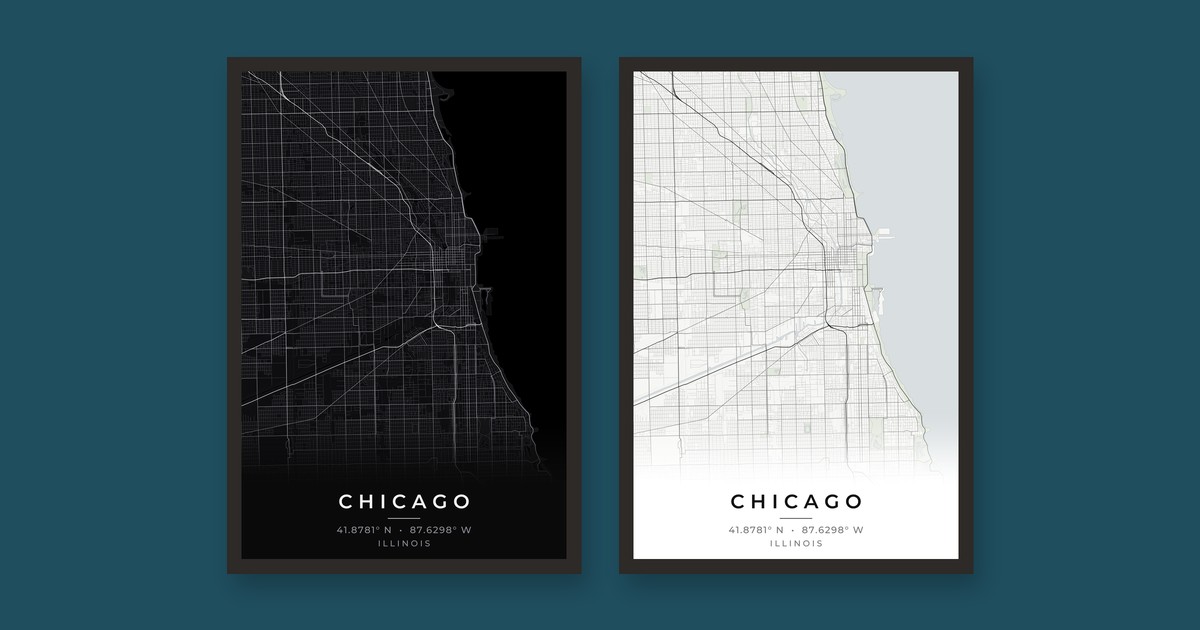
| Chicago | A square grid that stops at the lake | Ordered and strong |
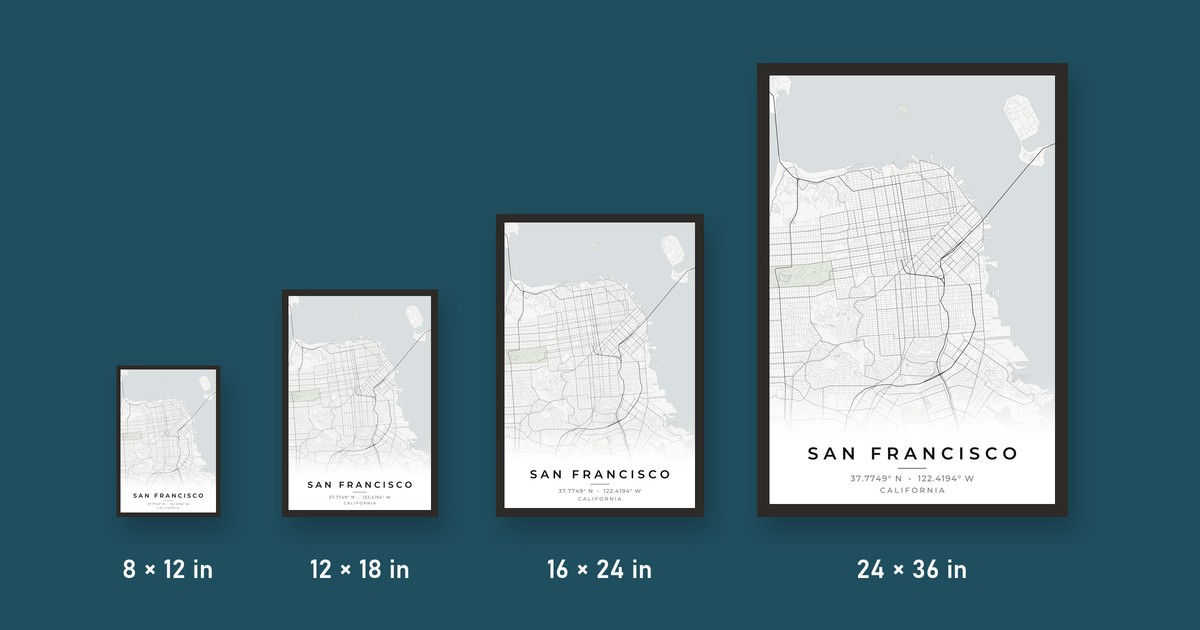
| San Francisco | Two grids set at angles on either side of Market Street | Lively |
| Boston | Winding streets around a harbor | Intricate |
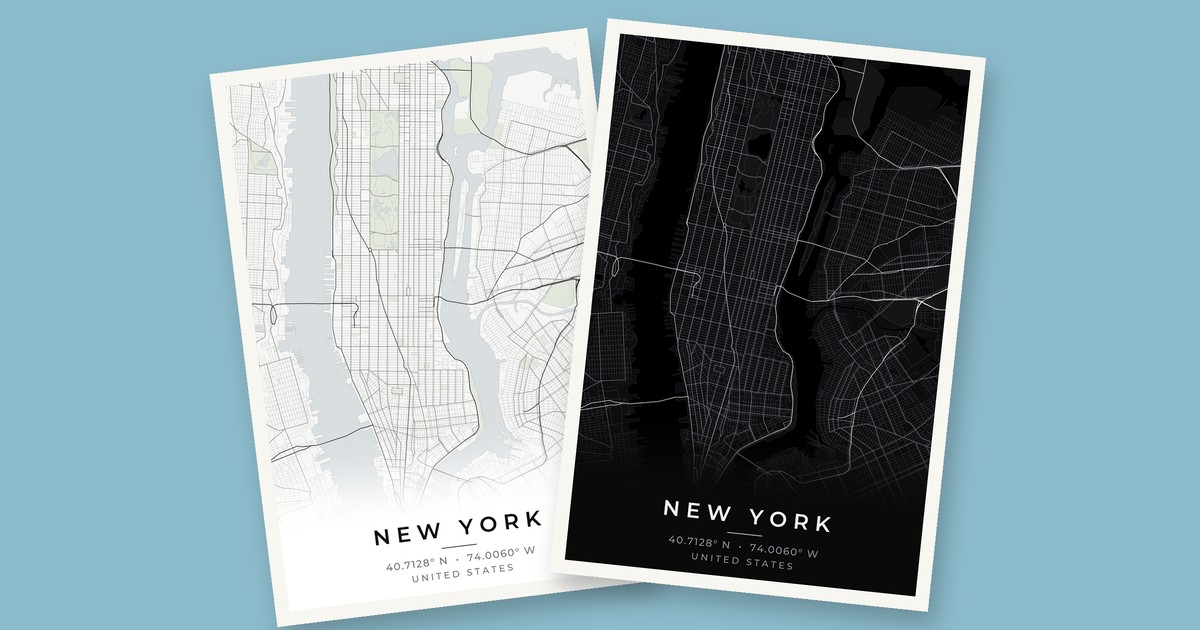
| New York | Manhattan standing between two rivers | Tall and iconic |
If two places matter to you equally, let the shape break the tie. Choose the one whose outline you could recognize from the doorway.
Test it before you commit
Open the city's preview on your screen, stand up and take three or four steps back. The shapes that survive the distance are the shapes your guests will see. If the map turns into an even gray texture, it belongs somewhere people stand close, such as above a desk or along a hallway.
Light or dark
Each city comes in two looks, and the choice changes the mood of the room more than the city does.
Gallery White is bright paper with fine dark streets and pale water. It settles easily into light rooms and sits well beside wood, linen and plants. On a deep wall such as green, rust or navy, it stands out like a window.
Noir Black is a black field with streets in light gray. It gives a plain wall a focal point at once and suits black metal, leather and dark wood. On a very dark wall, add a light mat or a pale frame so the edge does not vanish.
| Your room | Lean toward |
|---|---|
| White or pale walls, you want drama | Noir Black |
| White or pale walls, you want calm | Gallery White |
| Deep colored walls | Gallery White |
| Strong afternoon glare | Gallery White with matte paper |
| Black hardware and steel | Either, in a black frame |
| Pale wood and soft textiles | Gallery White in oak |
One honest warning: large dark prints behind glass reflect windows and lamps more than light ones. Matte paper and non-glare glazing solve most of it.
Choose the size from the furniture
Art above a sofa, bed or desk usually looks balanced when it spans about two thirds of the furniture's width. Measure, multiply, then compare.
| Above | Two thirds is about | An arrangement that fits |
|---|---|---|
| 48 in desk | 32 in | Two 12 × 18 in prints, 3 in apart (27 in), plus frames |
| 60 in bed | 40 in | Two 16 × 24 in prints, 3 in apart (35 in), plus frames |
| 84 in sofa | 56 in | Two 24 × 36 in prints, 4 in apart (52 in), plus frames |
On a narrow wall or in a nook, one 12 × 18 inch print is often enough. When in doubt, go one size up. A print that is slightly generous looks intentional, while a small one over a long sofa looks like an afterthought.
Tape paper to the wall in the size you are considering and live with it for a day. It costs nothing and answers the question better than any chart.
One print, two or three
One large print is the simplest and often the most striking choice. It suits a single clear story: the city.
A pair carries a relationship. The place you left and the place you moved to. Two hometowns under one roof. The same city in Gallery White and Noir Black, side by side, like day and night.
Three suit a long wall or a hallway. Use one frame finish and one gap throughout, so the eye reads a set instead of three separate purchases.
Hang it where eyes are
On an open wall, put the center of the art about 57 to 60 inches (145 to 152 cm) from the floor. Above furniture, leave 6 to 10 inches (15 to 25 cm) between the top of the piece and the bottom of the frame, even if that lifts or lowers the center.
Most pictures in homes hang too high, because a tall wall tempts you to fill it. Trust the number.
Three rooms, three answers
A bright living room with a long pale sofa. Two Noir Black prints at 24 × 36 inches give the wall a center. Choose cities with open water on different sides, so the pair feels balanced.
A small home office. One or two 12 × 18 inch prints above the desk, in a city with fine detail you can study between tasks. Gallery White stays readable behind you on video calls.
A narrow hallway. A row of small prints in one finish, each a place from your own story, in the order you lived them. Guests walk the timeline without being told what it is.
Notice that the wall chose the size each time, and the person chose the meaning.
Five mistakes that spoil a good map
- Choosing the size by price instead of by wall.
- Hanging one small print alone over long furniture.
- Buying the frame before checking that its opening has a 2:3 shape.
- Facing a dark glazed print toward a bright window.
- Hanging by ceiling height instead of eye height.
Each one can be prevented with a tape measure and a sheet of paper.
Common questions
Should the city be where I live now?
Not necessarily. Many people choose the place that shaped them. If you are torn, a pair holds both and often looks better than either alone.
Can I change my mind later?
With printable files you can. A pack holds all 25 cities in its style, so a new season, a move or a new memory only needs a new sheet of paper in the same frame.
Do the maps have street names?
No. The posters show streets, water and the city's name with its coordinates. The clean lines are what let each place be recognized by shape.
Your turn
You now have the order: wall, city, tone, size, height. See all 25 cities framed and notice which shape stops you. When you find it, the map poster packs give you every city in your chosen style at four print sizes from $14.99, ready to download. Check which frame fits each size and you can have it on the wall this week.